
Criminal Cases in the Middlesex County Courts
Middlesex County criminal cases divide by offense level. The Superior Court of New Jersey, Law Division, Criminal Part hears indictable crimes of the first through fourth degree. Its Middlesex Vicinage sits in New Brunswick. Municipal courts hear disorderly-persons and petty-disorderly-persons offenses, traffic matters, and local ordinance cases within their towns. A complaint may begin in municipal court and move to the Criminal Part after prosecutor screening when the alleged conduct supports an indictable charge. The Middlesex County Prosecutor represents the State in those indictable matters.
The custodian follows the court. The Middlesex Criminal Records Room maintains public Superior Court criminal files, including indictments, judgments, pleas, sentencing records, and orders that remain open under New Jersey Court Rule 1:38. Edison, Woodbridge, Old Bridge, and other municipal clerks maintain their own municipal files and certified dispositions. Neither clerk is the custodian of the arresting police department's incident report. That report is a separate record, and the booking file belongs to Adult Corrections if the person entered county custody.
Middlesex Criminal Court Jurisdiction
The charge label points toward the right Middlesex County court record. New Jersey calls felony-level offenses "indictable crimes," graded from first through fourth degree. Those cases belong in the Superior Court search and Criminal Records Room. A disorderly-persons offense is not called a misdemeanor under New Jersey law, even though it fills a similar lower-court role. It normally stays in municipal court. An accusation is a prosecutor-filed charging instrument used when indictment is waived, while an indictment is a grand jury's formal accusation. Neither document proves guilt.
Search both levels when the path is unclear. A municipal complaint identifier does not become a Superior Court indictment number merely because the events are related. Prosecutor screening can also change the filed charges. Saving the complaint, indictment or accusation, and case-status details prevents later confusion. Woodbridge Municipal Court offers a useful local example: its public instructions route a request for an exemplified disposition through the State Judiciary Records Request Form, while an indictable case moves to the Middlesex records room in New Brunswick.
How to Search Case Records
Use the New Jersey Courts criminal case tools for Superior Court matters and the separate Municipal Court Case Search for local complaints. PROMIS/Gavel is the public information view of the criminal tracking system used by courts, prosecutors, and law enforcement. It is not the attorney eCourts filing system, and it does not promise a free image of every filed document. Exact docket or indictment identifiers reduce false matches among common names.
- Open PROMIS/Gavel and select Middlesex for an indictable criminal case.
- Search by SBI number or indictment or accusation number when one is known.
- Use legal surname and first name, then try spelling variants for a name search.
- Read each count, status, and disposition instead of relying on the case caption alone.
- Request the judgment, dismissal order, or certified disposition from the correct court clerk.
| Field Label | Type | Required | Notes |
|---|---|---|---|
| County | Dropdown | Search-dependent | Select Middlesex |
| Defendant Last Name | Text | For name search | Try the legal surname and spelling variants |
| Defendant First Name | Text | Optional | Narrows a common-name result |
| SBI Number | Text | Alternate | Uses the State Bureau of Identification number |
| Indictment or Accusation | Text | Alternate | Enter the Judiciary docket format |
| Case Status or Year | Filter | Optional | Availability varies in the launched interface |
The Municipal Court Case Search interface uses ticket numbers, court IDs, and segmented prefix, year, and complaint numbers for its own files.
This separate screen is why a clear PROMIS/Gavel result does not rule out a Middlesex municipal charge or traffic matter.
Searching Middlesex Criminal Cases Online
PROMIS/Gavel can show the defendant, county, indictment or accusation identifier, charge information, and case status or disposition. It remains a public index, not a complete rap sheet or document repository. A no-result search may reflect a municipal case, alternate spelling, older archived material, indexing lag, an expungement, or a protected file. Mobile browsers may also display older Judiciary tools poorly, so a desktop browser is the sound fallback.
When the online view lacks a document, record the docket details and contact the court that owns the file. Use the Judiciary request route for an indictment, judgment, sentencing order, or certified disposition. Ask the municipal clerk for its own disposition. A police OPRA request cannot substitute for the court file, and a county OPRA submission is not the route for Judiciary records. The court system's access rules come from Rule 1:38.
Note: A public case search is not the fingerprint-supported New Jersey criminal history held by the State Police.
What the Case File Shows
A Middlesex County criminal case file tracks what the State filed and what the court did. It can hold the complaint, indictment or accusation, appearances, motions, plea, verdict, dismissal, judgment, sentence, and later orders. The docket supplies the event trail, while the signed order or judgment supplies stronger proof of an outcome. Read every count. One count may be dismissed while another ends in a plea or verdict, and a diversion entry is not the same as an acquittal.
| Case Number & Court | Names the vicinage, municipal court, and indictment, accusation, complaint, or ticket identifier. |
|---|---|
| Charging Document | Lists counts, statutory citations, offense degree, and the allegations formally presented. |
| Docket Entries | Records public filings, appearances, motions, and case status events. |
| Hearing Dates | Shows public arraignment and other scheduled or completed events when entered. |
| Disposition & Judgment | Identifies pleas, verdicts, dismissals, and the final judgment count by count. |
| Sentence & Conditions | May state custody, probation, fines, penalties, and restitution imposed by the court. |
Public copies omit full Social Security numbers, protected addresses, victim or minor names, and sealed content. Attorney details may appear when entered, but public access does not turn the attorney eCourts workspace into an open document download system. If the precise outcome matters, request the signed judgment or dismissal order rather than relying on a short status label.
Reading Middlesex Case Dispositions
Disposition means the outcome of a charge. A conviction is a judgment of guilt after a plea or verdict. An acquittal is a not-guilty determination. A dismissal ends a charge without conviction, while nolle prosequi records the prosecutor's decision not to continue it. Pretrial Intervention and Recovery Court have their own program entries and conditions. Those labels should be read in the context of the docket and final order.
- Indictment
- The grand jury's formal accusation, not a finding of guilt.
- Accusation
- A prosecutor-filed charge used when indictment is waived.
- Arraignment
- The formal presentation of charges and entry of a plea.
- Judgment of conviction
- The court document recording conviction and sentence.
- Expungement
- Statutory isolation of qualifying records under Title 2C, chapter 52.
A dismissal does not itself erase the underlying police, jail, court, and State Police records. Qualifying matters require the separate New Jersey expungement process. If a disposition is missing from a personal NJSP record, obtain a certified court disposition first. The clerk corrects the court file, while NJSP handles a challenge to the state repository entry.
Stages of a Criminal Case
A Middlesex County criminal case starts with a complaint and first appearance, followed by prosecutor screening. Indictable matters proceed by indictment or accusation in Superior Court. Arraignment places the charge and plea on the formal record. Discovery, motions, and negotiation follow before a plea or trial. The court then enters a disposition and, when guilt is established, a sentence. An appeal or later expungement creates a new record event rather than rewriting the earlier docket.
Case flow: Charges Filed › Arraignment › Pretrial › Plea or Trial › Disposition › Sentencing
The court record and arrest record can diverge during that sequence. The arresting agency records suspected offenses at the start. Prosecutors may amend, downgrade, dismiss, or replace them. The judgment controls the court outcome, so move from the initial arrest entry to the Middlesex County arrest history only when the booking trail itself is the question.
Middlesex Criminal Records Room Requests
The Middlesex Criminal Records Room is the source for copies and certifications from public Superior Court criminal files. Its mailing address is Middlesex County Courthouse, P.O. Box 964, New Brunswick, NJ 08903-0964. The courthouse itself is at 56 Paterson Street. Confirm the current room and extension through the Judiciary Criminal Records Room directory before visiting. Security screening applies, and accessibility or language access should be arranged through the vicinage when needed.
Describe an identifiable record. Include Middlesex County, the defendant's name, indictment or accusation number, document sought, and a useful date range. State whether a plain, certified, or exemplified copy is needed. The court's current fee schedule controls copy and certification charges. A request for a judgment should say so; asking broadly for "all criminal history" seeks a different product held by NJSP and can slow routing.
Middlesex Criminal Records Room
56 Paterson Street
New Brunswick, NJ 08901
Mail: P.O. Box 964, New Brunswick, NJ 08903-0964
Access & Restrictions
New Jersey Court Rule 1:38 governs access to Judiciary files. It creates a presumption of access but lists exclusions and permits sealing and redaction. Juvenile cases, expunged matters, sealed filings, protected victim and minor details, full personal identifiers, and some security or medical information do not become public through an online name search. Court access also differs from OPRA, which governs executive and local government records rather than Judiciary files.
When a Middlesex County case is missing, first verify the court level, spelling, and identifier. Then ask the appropriate clerk whether the file is archived, awaiting indexing, restricted, or held under another number. A clerk can explain access and process a records request but cannot disclose protected content. A no-result screen never proves that no arrest or case exists. It shows only that the selected public index returned no matching public entry.
Middlesex Federal Criminal Case Records
A federal prosecution arising in Middlesex County belongs to the U.S. District Court for the District of New Jersey, not the county Criminal Records Room. The District of New Jersey court supplies clerk and courthouse information, while federal dockets are searched through PACER after registration. County courts cannot certify a federal docket, and a sealed federal warrant will not surface simply because a user searches the docket system.
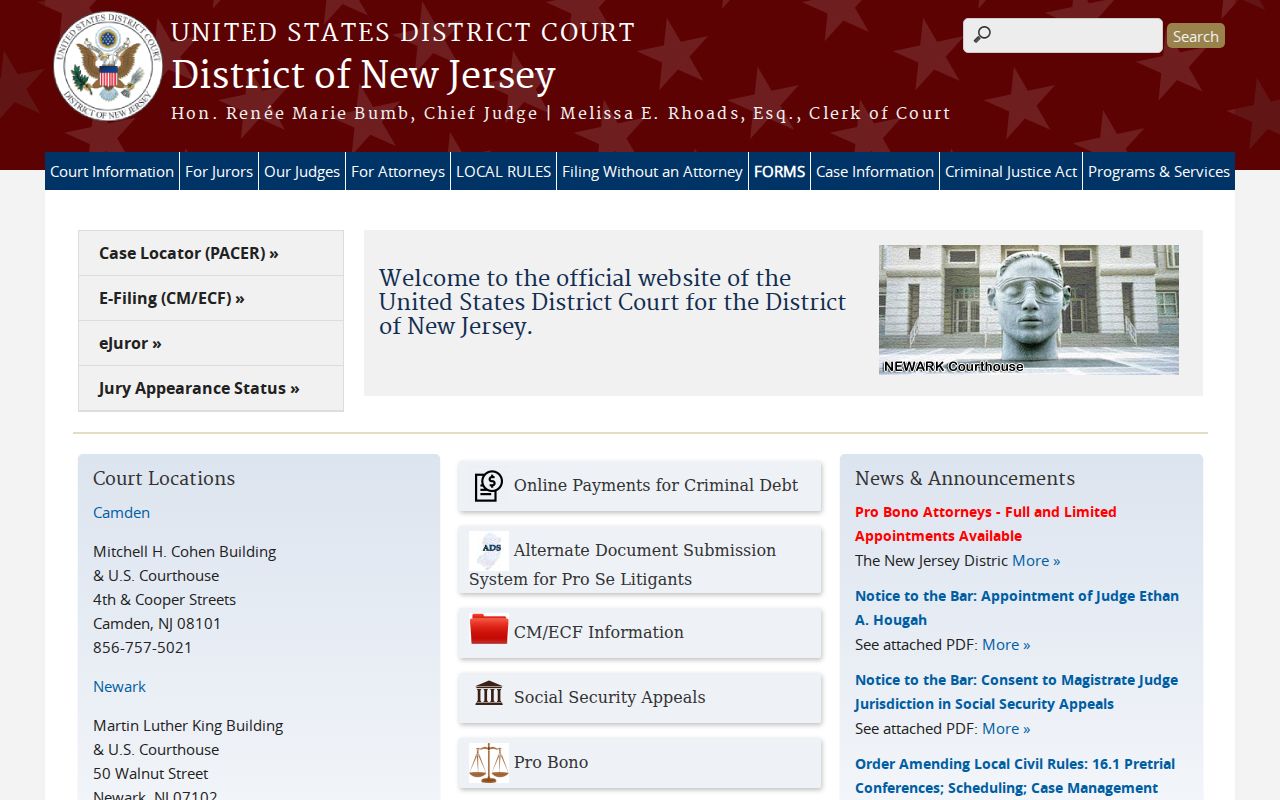
The district page identifies the proper federal court layer when a Middlesex event did not produce a state or municipal case.
The official PACER case access service applies its current per-page fee rules, document caps, and quarterly waiver threshold. Verify those amounts at PACER because they can change. Search results are docket records, not an NJSP criminal history or proof that an uncharged investigation exists.
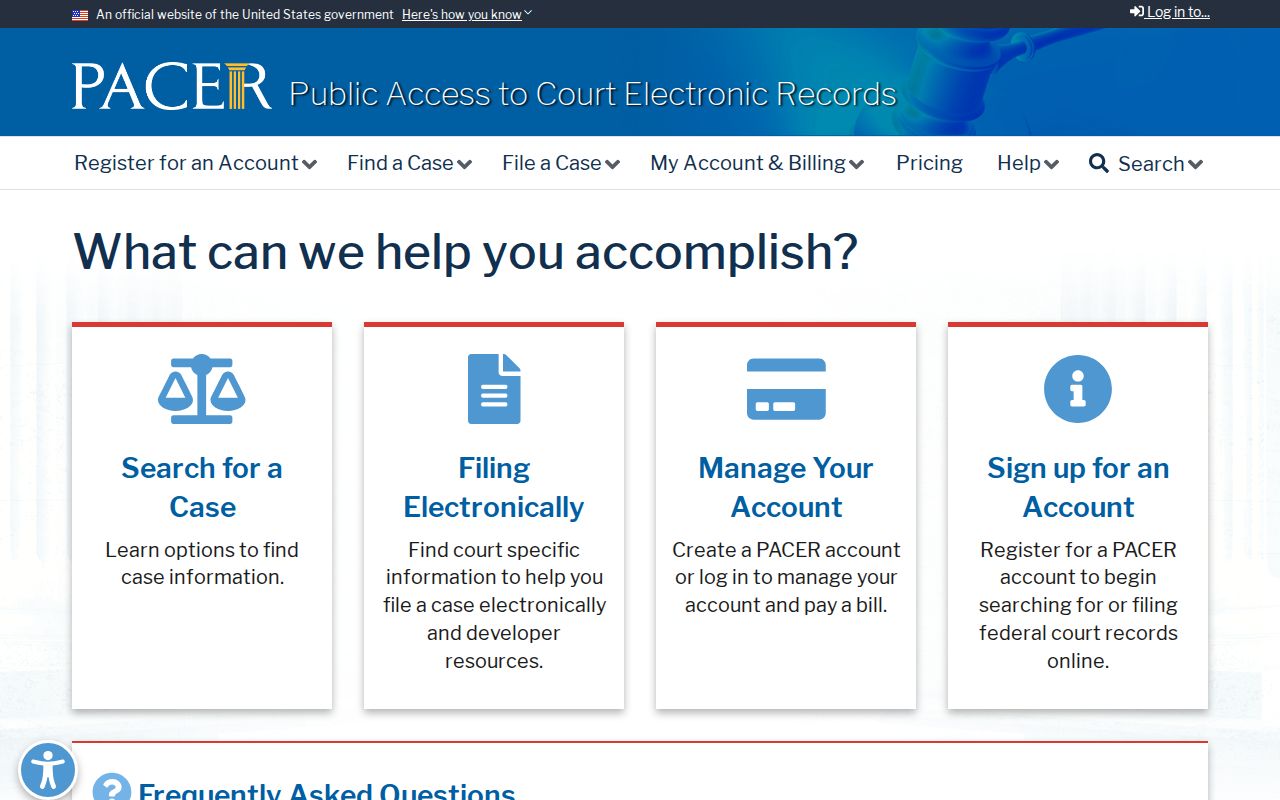
PACER completes the court-search path for federal matters while keeping state, municipal, and federal custodians distinct.