
Running a Sex Offender Check in Middlesex County
The New Jersey Sex Offender Internet Registry is the main public channel for a Middlesex County search. The New Jersey State Police manages it under Megan's Law. A reader can search a known name, select Middlesex County or a municipality, or use an address and radius where the live interface offers that path. The result is a public-safety record, not a full criminal history report. It reflects the tiers and information that New Jersey law permits NJSP to publish online.
Gather a first and last name, likely Middlesex municipality, ZIP code, or street address before starting. Search by name when checking a specific person. Use county, town, or radius criteria for awareness near a home, school route, park, or family destination. If a person has lived outside New Jersey, use the national channel as a second step. Questions about a Middlesex registration should go to local police, the Middlesex County Prosecutor's Megan's Law function, or NJSP. Do not visit a listed address or try to verify a record in person.
Middlesex Sex Offender Registry Routes
Middlesex County does not replace the state registry with a separate countywide public list. NJSP supplies the official Internet search, while municipal police and the Middlesex County Prosecutor's Office take part in registration, verification, classification, and compliance work. That split matters. The public searches one state system, but a concern about an address or missed registration goes to the agency charged with follow-up.
Choose the channel that fits the task. Use the NJSP registry for New Jersey public listings. Use the U.S. Department of Justice search when the relevant address or prior residence may be beyond the state. Contact the police department for the municipality tied to a current local concern. The Middlesex County Prosecutor's Office, at 25 Kirkpatrick Street, 3rd Floor, New Brunswick, NJ 08901, handles Megan's Law functions and can route county-level questions. NJSP remains the source for questions about the statewide Internet record.
Note: An empty Middlesex County result is not proof that no person at that place has a registration duty.
Searching the New Jersey Sex Offender Internet Registry
The official NJSP form supports both person-based and place-based checks. Start narrowly enough to limit false matches, but do not stop after one spelling or one town if the facts are uncertain. The search fields below reflect the public interface documented for the New Jersey Sex Offender Internet Registry. The live system controls exact matching behavior and radius choices, so read its current terms before submitting a search.
- Open the NJSP registry and review its conditions of use. Accept them only after reading the limits on publication and misuse.
- Enter a last name and, when known, a first name. For a place search, select Middlesex County, a municipality, ZIP code, or street address and radius.
- Review the result list without treating a matching name as proof of identity. Compare the image, age, physical description, and location details.
- Open the profile and read the offense, conviction jurisdiction and date, tier or notification status, compliance notation, and last update shown.
| Field Label | Type | Required | Notes |
|---|---|---|---|
| Last Name | Text | Name search | Use the spelling shown in official records; test live partial or exact behavior |
| First Name | Text | Optional | Narrows a name search |
| County | Dropdown | Geographic search | Select Middlesex, statewide, or all where offered |
| City/Municipality | Dropdown or text | Optional | Uses the community of registration |
| ZIP Code | Text | Optional | Use five digits |
| Street Address | Text | Address route | Use a normalized street address |
| Radius | Dropdown | Conditional | The live interface controls available mile distances |
| Search | Button | Submit | Accept the terms first if prompted |
| Clear/New Search | Button | No | Resets the criteria |
Reading Middlesex Registry Profiles
A sound match uses several fields at once. Start with the current photograph and physical descriptors. Then compare aliases, age or date-of-birth presentation, municipality, and address information at the level New Jersey allows online. Finally, read the offense block. The offense jurisdiction and conviction date describe the legal event, while the current address describes where the registrant is reported now. Those are different facts.
A profile may also show scars, marks, tattoos, vehicle information, school information, agency contacts, maps, or an update date when the current interface and law permit those fields. Absence of one field does not cancel the rest of the record. Publication limits vary by tier and court order. When two people share a name, do not infer identity from the name or town alone.
The official New Jersey State Parole Board offender-information page shows why registry and supervision channels should stay distinct.
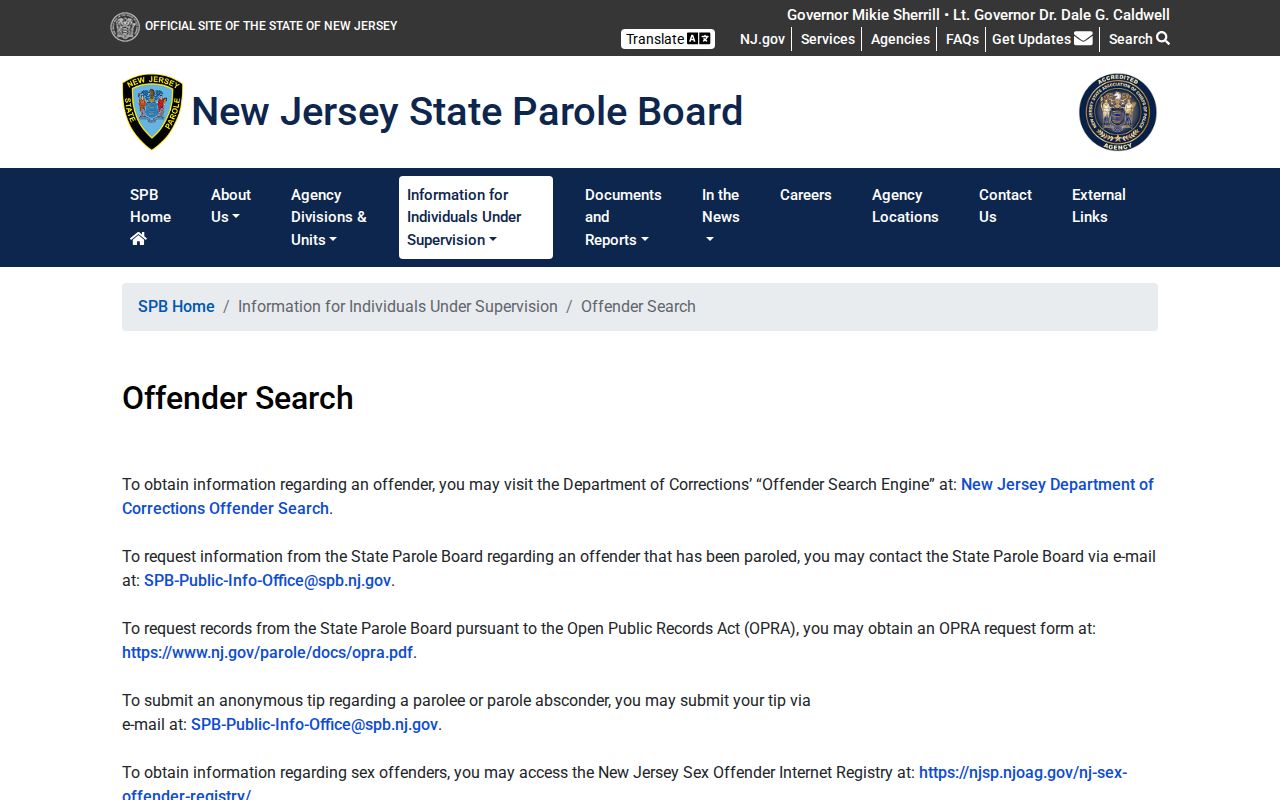
Parole status may be relevant to a sentence, but it does not replace the NJSP registry profile or its current registration details.
What a Registry Profile Shows
A public Middlesex County profile presents identifying and offense facts that New Jersey law authorizes for Internet release. It may leave out a registrant who is in a nonpublic tier, or omit details protected by law or court order. Read each field as a current official data point, not as an invitation to draw conclusions beyond the entry.
| Name & Aliases | Registered name plus known aliases released on the public profile |
|---|---|
| Photo & Physical Description | Current photograph with sex, race, height, weight, hair, eyes, and other published descriptors |
| Age Information | Date of birth or age presentation to the extent legally authorized |
| Registered Address | Municipality or address detail allowed for Internet publication |
| Offense & Statute | Offense description, jurisdiction or statute, conviction date, and victim-age category where authorized |
| Level / Tier | Risk tier or community-notification status shown by the official system |
| Registration Status | Compliance or notification notation and the update date where enabled |
| Other Identifiers | Published scars, marks, tattoos, vehicles, schools, agency contacts, and map links when available |
Note: A registry profile is not the full Middlesex criminal case file, rap sheet, or parole supervision record.
Middlesex Registry Search vs NSOPW
The NJSP registry is the direct source for New Jersey's public entries. The Dru Sjodin National Sex Offender Public Website, or NSOPW, is the cross-state layer run by the U.S. Department of Justice. NSOPW sends a query across participating jurisdictions. It is useful when a name, old address, travel route, or family concern extends outside Middlesex County, but the source jurisdiction still controls the underlying profile and what may be shown.
Use NJSP for a name, Middlesex municipality, ZIP, county, street, or radius search in New Jersey. Use NSOPW to check participating states, territories, and tribes. A local police department or the Prosecutor is the reporting channel for a possible Middlesex address or compliance problem, not another public database.
The DOJ's national registry search interface illustrates that wider search route.
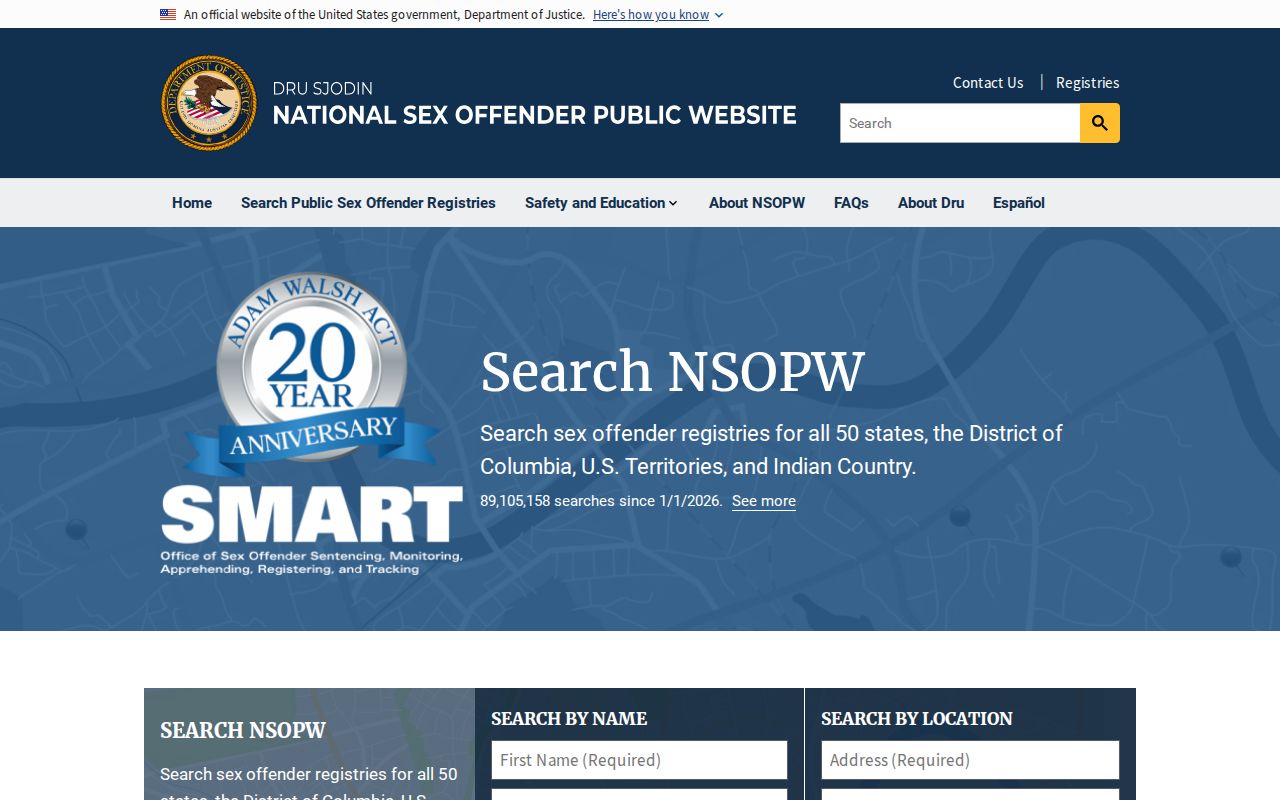
Use the national result to open and verify the record with the jurisdiction that supplied it.
Registration Requirements and Levels in New Jersey
New Jersey assigns risk-based tiers after prosecutor classification procedures and a court determination. These are not the federal SORNA tiers with fixed 15-year, 25-year, and lifetime periods. A New Jersey tier chiefly describes assessed risk and the scope of notification. Registration length comes from N.J.S.A. 2C:7 and the controlling order. Many people register for life, though some may petition after 15 offense-free years if every statutory condition and risk finding is met. Certain offenses and categories do not qualify for termination.
| NJ Risk Tier | General Meaning | Internet and Community Visibility | Duration Caution |
|---|---|---|---|
| Tier 1 | Low risk of reoffense | Law enforcement; generally not listed on the public Internet registry | The registration statute and court order control |
| Tier 2 | Moderate risk of reoffense | Schools and community organizations; qualifying Internet publication | Often lifetime unless statutory termination applies |
| Tier 3 | High risk of reoffense | Broad public and community notification plus Internet publication | Often lifetime; the statute and order control |
Verification duties are set by law and the person's order, and the research does not support one fixed check-in schedule for every Middlesex County tier. The County Prosecutor and local police coordinate their duties with NJSP. A missed or changed detail should be sent to those officials, not tested by a member of the public.
Middlesex Registry Tier Visibility Gaps
A Tier 1 registrant is generally known to law enforcement but does not ordinarily appear on New Jersey's public Internet registry. Tier 2 publication is also limited to qualifying cases. As a result, a blank public search can mean that no eligible Internet listing matched the terms. It cannot establish that no person is registered, that an address has never been linked to a registrant, or that a person has no criminal case.
The distinction prevents two common errors. First, the New Jersey risk tier should not be converted into a federal duration label. Second, the 15-year petition route is not automatic removal. A person must meet the statutory conditions and obtain the required risk finding. Until an official record changes, a member of the public should rely on the current NJSP display and avoid assumptions about a missing entry.
Lawful Use and Community Notification
Megan's Law notification supports personal, family, and community safety. Middlesex County Tier 2 notification may reach schools and community organizations, while Tier 3 allows broad public notice. The public Internet registry gives eligible entries a statewide channel. Use those facts to plan safe routines, speak with family members in an age-appropriate way, and contact police when conduct raises a real concern. Registry information is not permission to confront, follow, expose, or punish a listed person or anyone at the address.
Misuse is a crime: N.J.S.A. 2C:7-16 penalizes using Megan's Law information to commit a crime or disorderly persons offense. Never threaten, intimidate, harass, or take vigilante action against a registrant or household.
Reporting Middlesex Registry Errors
If a Middlesex County profile looks stale, record the public page, the field at issue, and the date viewed. Do not gather more facts by visiting the address, contacting neighbors, or approaching the person. For a suspected local registration or compliance issue, contact the police department for that municipality or the Middlesex County Prosecutor's Megan's Law function. NJSP is the proper source for a statewide Internet-display question.
Give the official agency enough neutral detail to locate the entry, such as the displayed name, municipality, profile reference, and the field that appears wrong. Avoid conclusions about guilt or intent. An old photograph, move, data delay, spelling difference, or lawful publication limit can each affect what a user sees. Officials can compare the report with nonpublic records and decide whether follow-up is needed.
For an emergency or conduct that poses an immediate threat, call emergency services. For a routine data concern, use the agency's published contact route and allow it to verify the record.